
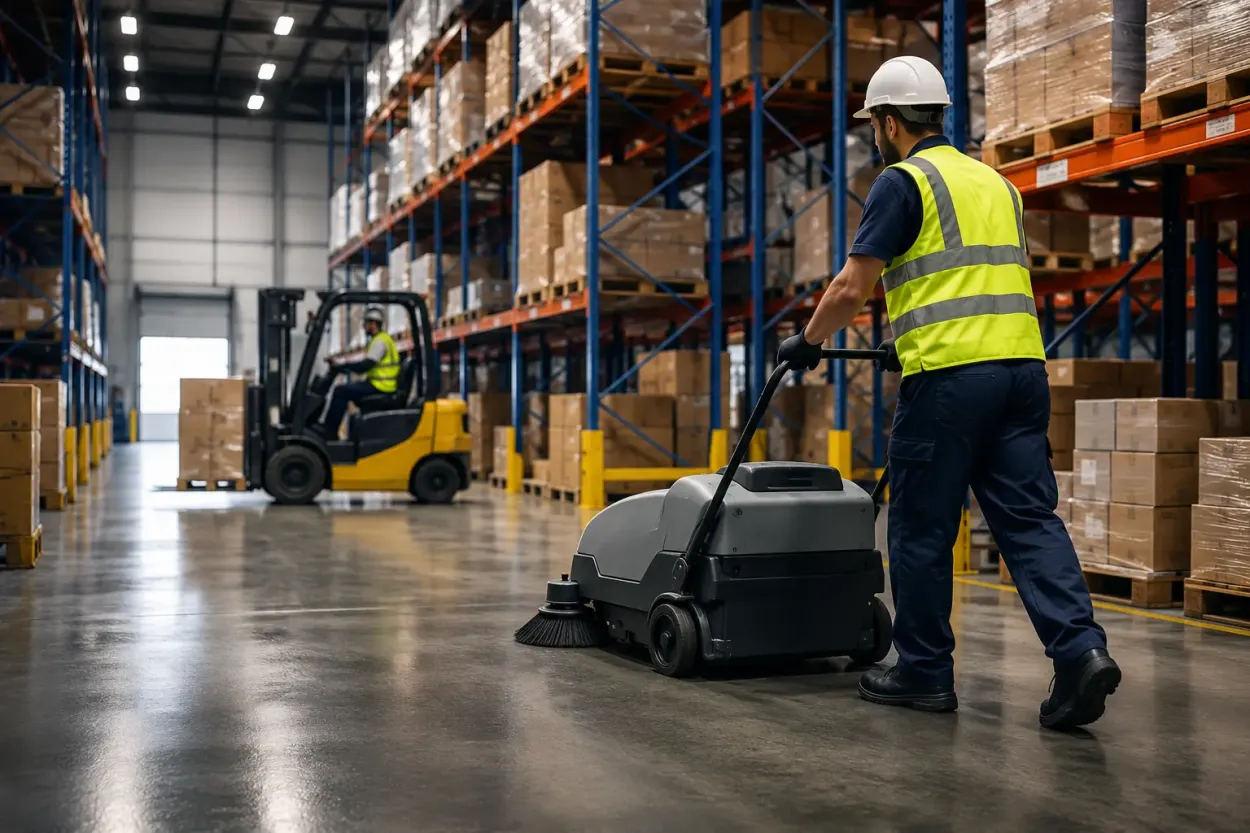
Picture a busy warehouse at the end of a long shift. Forklifts have been moving nonstop. Pallets have been loaded and unloaded all day. Dust has settled on racking, debris has collected in traffic lanes, and a small spill near a loading dock has gone unnoticed.
At first glance, everything seems normal.
But over time, these small issues create bigger problems. Dust buildup can affect equipment performance. Dirty floors increase slip and trip hazards. High-level dust accumulation can even become a fire risk in some industrial environments. Most importantly, poor warehouse cleaning frequency can lead to downtime, safety incidents, compliance concerns, and increased operating costs.
So how often should your warehouse cleaning frequency be scheduled for a high-traffic facility?
The answer depends on several factors, including facility size, industry type, traffic volume, materials handled, and regulatory requirements. However, one thing is clear: warehouses that rely on a proactive cleaning schedule perform better, stay safer, and operate more efficiently.
At MCA Group, we’ve been providing commercial and industrial cleaning services across Toronto, the GTA, and Ontario since 1993. With more than 30 years of experience supporting logistics centers, distribution facilities, manufacturing plants, and industrial warehouses, we’ve learned that customized cleaning schedules deliver the best results.
In this guide, we’ll explain the ideal warehouse cleaning frequency for high-traffic facilities and share practical insights from real-world industrial environments.
Why Warehouse Cleaning Frequency Matters
Establishing the right warehouse cleaning frequency helps reduce safety risks, improve operational efficiency, and support compliance.
Many facility managers view cleaning as a maintenance expense.
Experienced warehouse operators know it’s an operational investment.
1. Improved Safety
According to workplace safety organizations, slips, trips, and falls remain among the most common workplace injuries. Dust, debris, packaging waste, and liquid spills significantly increase these risks.
Regular cleaning helps:
- Reduce slip and fall hazards
- Keep emergency exits clear
- Improve visibility of floor markings
- Minimize forklift accidents
- Reduce fire hazards caused by combustible dust
2. Better Productivity
We’ve seen warehouses lose valuable time because employees must navigate cluttered aisles or work around uncleaned spills.
Clean facilities support:
- Faster material movement
- Improved workflow efficiency
- Better inventory visibility
- Reduced equipment interruptions
3. Compliance and Audits
Warehouses often face inspections from clients, insurers, safety auditors, and regulatory bodies.
A documented high-traffic warehouse cleaning schedule helps demonstrate:
- Good housekeeping practices
- Safety compliance
- Risk management efforts
- Operational professionalism
4. Lower Long-Term Costs
A common mistake is delaying cleaning to save money.
In reality, neglect often leads to:
- Premature floor deterioration
- Equipment damage
- Higher repair costs
- Increased workers’ compensation claims
- Production downtime
Preventative cleaning is almost always less expensive than corrective cleaning.
Factors That Determine Warehouse Cleaning Frequency
Every facility should determine its warehouse cleaning frequency based on traffic volume, industry, and operational requirements.
No two warehouses operate exactly the same way.
Here are the key factors MCA Group evaluates when creating industrial cleaning programs.
Traffic Volume
The more forklift traffic and employee movement a warehouse experiences, the more frequently cleaning is required.
High-traffic zones include:
- Shipping areas
- Receiving docks
- Main aisles
- Packing stations
- Break rooms
A distribution center operating 24/7 requires more frequent cleaning than a warehouse running a single shift.
Industry Type
Different industries generate different contaminants.
| Industry | Common Cleaning Challenges |
|---|---|
| Logistics & Distribution | Dust, pallet debris, tire marks |
| Manufacturing | Oils, metal shavings, residue |
| Food Warehousing | Organic waste, contamination risks |
| Pharmaceutical | Strict sanitation requirements |
| Retail Distribution | Cardboard dust, packaging debris |
Materials Handled
Facilities storing powdered products, paper goods, wood products, or chemicals often require more frequent cleaning due to airborne particles and residue accumulation.
Seasonal Conditions
Ontario weather creates unique cleaning demands.
During winter, warehouses experience:
- Salt tracking
- Snow and moisture accumulation
- Increased slip hazards
During spring and summer:
- More dust infiltration
- Increased pollen and debris
Facility Size and Layout
Large warehouses often need a combination of daily maintenance and scheduled deep cleaning.
Facilities with high ceilings and extensive racking systems require specialized cleaning approaches.
Recommended High-Traffic Warehouse Cleaning Schedule
The following schedule reflects best practices for most high-volume industrial facilities.
Daily Cleaning Tasks
| Task | Frequency |
|---|---|
| Sweep traffic lanes | Daily |
| Remove debris from aisles | Daily |
| Empty waste bins | Daily |
| Clean washrooms | Daily |
| Spot clean spills | Immediate |
| Sanitize touchpoints | Daily |
| Inspect loading docks | Daily |
Weekly Cleaning Tasks
| Task | Frequency |
|---|---|
| Mechanical floor scrubbing | Weekly |
| Clean dock doors | Weekly |
| Dust low-level surfaces | Weekly |
| Remove pallet debris | Weekly |
| Clean break rooms | Weekly Deep Clean |
Monthly Cleaning Tasks
| Task | Frequency |
|---|---|
| Clean warehouse racking | Monthly |
| Detailed floor maintenance | Monthly |
| Equipment area cleaning | Monthly |
| Vent cleaning inspections | Monthly |
| Safety marking inspection | Monthly |
Quarterly Cleaning Tasks
| Task | Frequency |
|---|---|
| High-level dusting | Quarterly |
| Ceiling and beam cleaning | Quarterly |
| Lighting fixture cleaning | Quarterly |
| Comprehensive deep clean | Quarterly |
| Industrial pressure washing (where applicable) | Quarterly |
Annual Cleaning Projects
| Task | Frequency |
|---|---|
| Full facility deep clean | Annually |
| Specialized floor restoration | Annually |
| Ventilation system cleaning | Annually |
| Warehouse condition assessment | Annually |

Understanding High-Level Dusting and Combustible Dust
Many warehouse managers are unfamiliar with these terms until they become a problem.
What Is High-Level Dusting?
High-level dusting refers to cleaning elevated surfaces such as:
- Ceiling beams
- Racking tops
- Ductwork
- Light fixtures
- Overhead structures
Dust accumulates slowly but continuously in warehouses.
Without regular removal, it eventually falls onto inventory, equipment, and work areas.
What Is Combustible Dust?
Combustible dust is fine particulate material that can ignite under certain conditions.
Examples include:
- Wood dust
- Grain dust
- Paper dust
- Plastic dust
- Metal dust
Industrial safety organizations stress the importance of controlling combustible dust accumulation because excessive buildup can contribute to fire and explosion risks.
Common Warehouse Cleaning Challenges and Solutions
Challenge #1: Constant Dust Buildup
Problem:
A GTA distribution center recently noticed excessive dust collecting on inventory despite weekly sweeping.
Solution:
The issue was traced to overhead racking and ventilation areas that had not been cleaned in over a year.
After implementing quarterly high-level dusting and monthly rack cleaning, airborne dust levels dropped significantly.
Challenge #2: Dirty Forklift Lanes
Problem:
Heavy forklift traffic leaves tire marks, dust trails, and debris accumulation.
Solution:
Mechanical floor scrubbing combined with daily sweeping helps maintain safe and visible travel routes.
Challenge #3: Spill Response Delays
Problem:
Even a small hydraulic fluid spill can create a major safety hazard.
Solution:
Implement a documented spill response procedure:
- Secure the area immediately
- Stop the source if possible
- Use appropriate absorbent materials
- Remove contaminated waste
- Clean and inspect the surface
- Document the incident
Fast response prevents injuries and operational disruption.
Challenge #4: Cleaning Without Downtime
Problem:
Busy warehouses cannot stop operations for cleaning.
Solution:
Professional industrial cleaning teams schedule work during:
- Night shifts
- Weekends
- Planned shutdowns
- Low-volume operating periods
Latest Trends in Warehouse Cleaning
Warehouse cleaning continues to evolve.
Robotics and Autonomous Floor Cleaning
Many large facilities now use robotic floor scrubbers that operate during off-hours.
Benefits include:
- Consistent cleaning
- Reduced labor requirements
- Improved floor appearance
Green Cleaning Programs
Sustainability has become a priority for many Ontario businesses.
Modern warehouse cleaning programs often include:
- Eco-friendly cleaning products
- Reduced water consumption
- Waste diversion initiatives
- Sustainable consumables
Smart Monitoring Technology
Advanced facilities increasingly use:
- IoT sensors
- Traffic monitoring systems
- Predictive maintenance software
These technologies help identify cleaning needs before issues become costly.
Data-Driven Cleaning Schedules
Instead of fixed schedules, some facilities now adjust cleaning frequency based on actual warehouse activity levels.
This improves efficiency while controlling costs.
Warehouse Cleaning Checklist
Use this quick checklist to evaluate your facility.
Daily
- Floor debris removed
- Waste containers emptied
- Spills cleaned immediately
- Washrooms sanitized
- Traffic lanes clear
Weekly
- Floor scrubbed
- Dock areas cleaned
- Break rooms deep cleaned
- Dust removed from accessible surfaces
Monthly
- Racking inspected and cleaned
- Equipment areas cleaned
- Vent inspections completed
- Safety markings checked
Quarterly
- High-level dusting completed
- Deep cleaning performed
- Lighting fixtures cleaned
- Warehouse assessment conducted
If several items are being missed regularly, it may be time to review your warehouse cleaning frequency.
When Should You Hire Professional Warehouse Cleaners?
Many warehouses manage routine cleaning internally.
However, professional support becomes valuable when:
- Dust accumulates rapidly
- Ceiling heights exceed safe access limits
- Deep cleaning is overdue
- Compliance requirements increase
- Internal staff cannot keep up
- Operations run around the clock
Professional industrial cleaners have specialized equipment, training, and safety certifications that allow them to handle complex warehouse environments efficiently.
How MCA Group Helps High-Traffic Warehouses Across Toronto and Ontario
For more than 30 years, MCA Group has helped warehouses, logistics facilities, distribution centers, and industrial operations maintain safe, productive environments.
Our certified and fully insured cleaning teams provide:
- Customized warehouse cleaning programs
- Daily janitorial services
- Industrial floor scrubbing
- High-level dusting
- Deep cleaning services
- Loading dock cleaning
- Post-construction cleanup
- Emergency response services
We understand that every facility operates differently.
That’s why we develop cleaning schedules based on your traffic volume, industry requirements, operating hours, and compliance goals.
Whether you manage a logistics hub in Toronto, a distribution center in the GTA, or an industrial warehouse anywhere in Ontario, MCA Group can help create a cleaning program that protects your people, inventory, and operations.
Request a free warehouse cleaning assessment today.
Conclusion
There is no universal answer to warehouse cleaning frequency.
However, high-traffic facilities should generally combine:
- Daily maintenance cleaning
- Weekly floor care
- Monthly detailed cleaning
- Quarterly deep cleaning and high-level dusting
The right schedule reduces safety risks, improves productivity, supports compliance, and lowers long-term operating costs.
The most successful warehouse operators don’t wait for problems to appear. They implement proactive cleaning programs designed around their facility’s unique needs.
With over 30 years of commercial and industrial cleaning experience throughout Toronto, the GTA, and Ontario, MCA Group helps businesses create customized cleaning plans that keep warehouses safe, efficient, and inspection-ready year-round.
Ready to improve your warehouse cleaning program? Contact MCA Group today for a free assessment and customized quote. Call (416) 884-1652 or visit mcagroup.ca.
Sources
- OSHA – Housekeeping and Walking-Working Surfaces Guidelines
- OSHA – Combustible Dust National Emphasis Program
- IPC Worldwide – Cleaning Industry Best Practices
- Cleaning & Maintenance Management (CMM) – Industrial Facility Cleaning Resources
- Cleanfax & CleanLink Industry Publications
- ISSA – Cleaning Industry Standards and Facility Maintenance Guidance
Author Bio
Written by the MCA Group team, experts in commercial and industrial cleaning.


