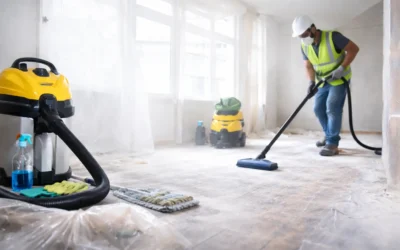
Vinyl composition tile floors in commercial buildings across the Greater Toronto Area represent a significant capital investment. outsourced commercial cleaning services Yet most facility managers replace VCT flooring after just 5 to 7 years due to preventable wear, discoloration, and structural damage. The difference between premature replacement and a full 10-year lifespan comes down to implementing a systematic VCT floor maintenance schedule, including strip and wax cycles, that protects the wear layer while maintaining a professional appearance.
This technical guide provides facility managers, building owners, and commercial cleaning contractors with a month-by-month VCT floor maintenance protocol based on traffic density, floor composition, and seasonal conditions specific to Ontario’s commercial environment. The schedule balances operational costs against floor longevity, delivering measurable return on investment through extended tile lifespan and reduced emergency restoration expenses.
Understanding VCT Floor Composition: Why VCT floor maintenance Matters
Vinyl composition tile consists of polyvinyl chloride resin (15% to 30%), limestone or calcium carbonate filler (50% to 65%), plasticizers (10% to 15%), and color pigments (3% to 8%). This composite structure creates a durable but porous flooring material that requires protective finish coatings to resist wear, staining, and moisture penetration.
The wear layer—the top 0.5 to 1.5 millimeters of tile—contains the color pigments and determines floor appearance. Once this thin layer erodes, the underlying filler material shows through as white or grey streaks that cannot be restored through cleaning alone. Traffic patterns in office corridors, retail checkout areas, and hospital hallways can wear through this layer in 18 to 36 months without adequate finish protection.
Floor finish serves three critical functions. First, it creates a sacrificial barrier that absorbs wear instead of the tile itself. Second, it fills the microscopic pores in VCT that would otherwise trap dirt, bacteria, and moisture. Third, it provides the glossy appearance that defines professional-looking commercial floors. Without proper finish VCT floor maintenance, VCT becomes permanently stained, harbors odor-causing bacteria, and develops surface cracks that lead to tile breakage.
The strip and wax cycle removes degraded finish layers and applies fresh protective coatings before wear reaches the tile surface. Timing these cycles correctly—based on actual floor condition rather than arbitrary calendar intervals—maximizes both appearance and tile longevity.
VCT Traffic Classification: Determining Your Baseline Schedule
Commercial floors experience vastly different wear rates depending on foot traffic volume and type. Establishing accurate traffic classification forms the foundation of an effective maintenance schedule.
Light Traffic (fewer than 100 people per day): Executive offices, administrative areas, conference rooms used occasionally, back-office spaces with limited access. These areas show minimal visible wear patterns and accumulate soil slowly. Floors maintain gloss levels above 70% for extended periods between wax applications.
Medium Traffic (100 to 500 people per day): General office spaces, medical clinic waiting rooms, retail back-of-house areas, small restaurant dining rooms, educational facility classrooms. Moderate foot traffic creates visible traffic lanes within 3 to 6 months of wax application. Gloss reduction occurs predictably but gradually.
High Traffic (500 to 2,000 people per day): Main building lobbies, elevator banks, primary corridors in multi-tenant buildings, retail sales floors, hospital public areas, cafeterias, gym facilities. Heavy foot traffic degrades floor finish rapidly. Traffic lanes become visible within 4 to 8 weeks, and edge areas show black heel marks requiring daily attention.
Very High Traffic (over 2,000 people per day): Shopping mall concourses, airport terminals, major transit stations, convention center exhibit halls, stadium concessions areas, large hotel lobbies. Extreme traffic volumes require specialized finish formulations and condensed maintenance cycles. Standard wax products fail within 2 to 3 weeks under these conditions.
For Toronto commercial buildings, traffic classifications shift seasonally. Office towers experience medium traffic during summer months when vacation schedules reduce occupancy but jump to high traffic during September to December when business activity peaks. Retail environments show the reverse pattern, with very high traffic from November through January holiday periods.
The 10-Year VCT floor maintenance Schedule: Month-by-Month Protocol
This schedule assumes medium to high traffic VCT flooring in a typical GTA commercial environment—office buildings, medical facilities, retail spaces, or mixed-use properties. Adjust frequencies based on your specific traffic classification and visible floor condition.
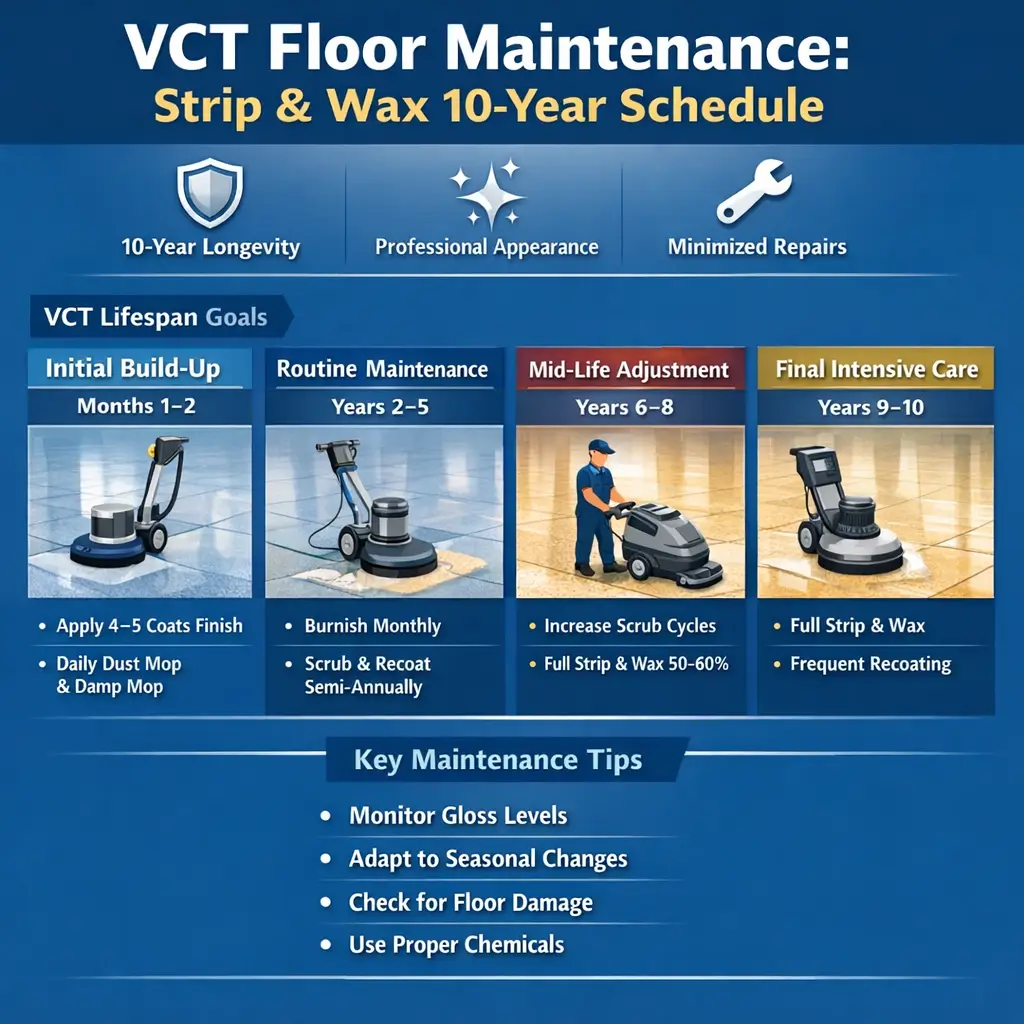
Year 1: Establishing the Foundation
Month 1-2 (Initial Installation or Major Restoration): New VCT requires 72 hours of curing time after installation before any finish application. During this period, dry dust mop daily but avoid wet cleaning that can drive moisture into tile adhesive. After curing, apply 4 to 5 coats of high-solids acrylic floor finish (20% to 25% solids content). Allow 30 to 45 minutes drying time between coats. This creates a baseline finish thickness of 3 to 4 mils that provides adequate wear protection.
Month 3: Implement daily dust mopping or dry sweeping to remove abrasive soil particles before they embed in finish. Damp mop with neutral pH cleaner (pH 7 to 9) twice weekly in high-traffic areas, weekly in medium-traffic zones. Monitor gloss levels—floors should maintain 75% to 85% gloss measurements in main traffic areas.
Month 4-5: Apply first burnishing cycle. Use ultra-high-speed burnisher (1,500 to 3,000 RPM) with red or beige buffing pad. Burnishing melts the top layer of finish through friction heat, flowing it back together and restoring gloss without adding new finish. This process extends time between recoat cycles by 30% to 40%. Burnish monthly in high-traffic areas, every 6 to 8 weeks in medium-traffic zones.
Month 6: Perform first spray buffing maintenance. This wet burnishing technique applies a thin mist of floor finish restorer (not full-strength finish) while buffing, filling minor scratches and refreshing gloss. Spray buffing removes light scuff marks and black heel marks that dry burnishing cannot address. Use this method every 4 to 6 weeks between scrub-and-recoat cycles.
Month 8-9: Execute first scrub-and-recoat cycle. This process deep scrubs the floor with automatic scrubber using mildly alkaline cleaner (pH 9 to 10), removing the top 1 to 2 layers of degraded finish along with embedded soil. After thorough rinsing and drying, apply 2 to 3 fresh coats of finish. Scrub-and-recoat restores appearance without the labor and downtime of full stripping. Schedule this every 6 to 8 months in high-traffic areas, annually in medium-traffic zones.
Month 12: Complete first-year evaluation. Measure floor gloss levels (should exceed 70% in traffic areas), inspect for finish buildup in corners and edges, check for discoloration or staining penetrating through finish. Document baseline conditions with photographs for year-over-year comparison.
Year 2-3: Routine Maintenance Phase
Quarterly (Every 3 Months): Continue spray buffing in high-traffic areas. Traffic lanes in main corridors and entry areas require more frequent attention than perimeter spaces. Some facility managers shift to bi-weekly spray buffing in elevator lobbies and building entrances during wet winter months when salt residue accelerates finish degradation.
Semi-Annually (Every 6 Months): Perform scrub-and-recoat cycles on high-traffic flooring. Medium-traffic areas can extend to 8 to 10 month intervals if daily maintenance keeps floors clean. During each recoat, inspect for areas where finish has worn completely through to tile. These locations indicate traffic pattern changes or inadequate finish thickness that requires adjustment in maintenance frequency.
Annually (Month 24 and 36): Complete full strip and wax on 30% to 40% of total VCT flooring—specifically the highest traffic areas where finish buildup, edge discoloration, or embedded soil cannot be resolved through scrub-and-recoat. This rotating schedule prevents the need to strip entire facilities simultaneously while ensuring high-visibility areas maintain optimal appearance.
Winter Months (December to March in GTA): Toronto’s winter conditions introduce road salt tracked into buildings on shoes. Calcium chloride and sodium chloride in de-icing products attack floor finish, creating white haze and accelerated breakdown. Increase damp mopping frequency to daily during winter months. Use neutral cleaners specifically formulated to neutralize salt (pH 6 to 7 with chelating agents). Consider applying sacrificial wax coats in entrance areas during November—these extra layers provide additional protection during the harshest months and can be stripped in March without affecting the base finish system.
Year 4-5: Mid-Life Assessment and Adjustment
Month 48 (Year 4 Completion): Conduct comprehensive floor assessment. Measure finish thickness in traffic versus non-traffic areas using wet film thickness gauge. Examine tiles for structural damage—cracks, chips, lifting edges. Document areas where color has faded or shifted, indicating potential wear layer compromise. This mid-life assessment determines whether your maintenance schedule provides adequate protection or requires frequency adjustments.
Expected conditions at Year 4 with proper VCT floor maintenance: Finish thickness of 2 to 3 mils in traffic areas (down from initial 3 to 4 mils), minimal tile damage (fewer than 5% of tiles showing any structural issues), uniform color appearance across flooring (no significant fading or discoloration in traffic lanes), gloss levels above 60% in high-traffic areas after routine maintenance.
Month 48-60 (Year 4-5): Increase scrub-and-recoat frequency by 20% to 30% as tile approaches middle age. Acrylic finish adhesion decreases slightly on aged VCT, so building finish thickness becomes more challenging. Some facility managers introduce hybrid maintenance—combining traditional acrylic finish with newer polymer-fortified products that offer improved wear resistance. This transition works best during the Year 4 to 5 window before significant tile degradation occurs.
Year 6-8: Intensive Maintenance Phase
Semi-Annually: Expand full strip and wax cycles to 50% to 60% of total flooring. As VCT ages, finish buildup in low-traffic areas creates uneven appearance compared to frequently maintained high-traffic zones. Strategic stripping of these areas normalizes floor appearance and prevents yellowing from finish oxidation. Older finish layers oxidize over 3 to 5 years, developing yellow or amber tint that cannot be corrected without complete removal.
Quarterly: Implement deep scrubbing with rotary brush machines (not just automatic scrubbers) in high-traffic areas. Rotary brushes provide more aggressive mechanical action that removes embedded soil and degraded finish that standard scrubber pads miss. This intensive cleaning extends the interval between full stripping by 2 to 4 months, reducing labor costs and operational disruption.
Monthly: Increase spray buffing to twice-monthly or weekly in very high-traffic areas. Aging VCT shows wear more quickly because the surface has become more porous over years of foot traffic, even with proper finish protection. More frequent interim maintenance compensates for reduced tile density.
Year 9-10: Maximizing Final Service Life
Month 96-108: Complete facility-wide strip and wax. At this stage, VCT has undergone multiple maintenance cycles, and finish adhesion varies across the floor. Full stripping normalizes the surface, allowing assessment of actual tile condition. Some areas may show wear layer thinning—visible as lightening of color or loss of pattern definition. These sections require monitoring but can continue in service with proper finish protection.
Month 108-120: Implement maximum maintenance frequency—scrub and recoat every 3 to 4 months in high-traffic areas, spray buff weekly or bi-weekly, daily dust mopping and spot cleaning. This intensive schedule protects tile during its final service years when wear resistance has decreased.
Month 120 (Year 10 Completion): Final assessment and replacement planning. VCT that reaches 10 years with proper maintenance shows expected wear patterns: moderate color fading in traffic lanes (10% to 20% lighter than original), minimal structural damage (fewer than 10% of tiles with cracks or chips), intact wear layer across 85% to 90% of flooring, no widespread moisture damage or adhesive failure.
At this point, facility managers face the economic decision: continue with intensive maintenance for Years 11-12, or plan systematic replacement. Factors include aesthetic standards for the facility, budget constraints, and whether flooring failures would disrupt operations. Many GTA commercial properties begin phased replacement in Year 10, replacing highest-traffic areas while maintaining lower-traffic zones for an additional 2 to 3 years.
Floor Finish Selection: Chemistry That Impacts Longevity
Not all floor finishes deliver equal protection or longevity. Product selection directly affects maintenance frequency and tile lifespan.
Standard Acrylic Finishes (18% to 22% solids): Economical option for budget-conscious facilities. Provides adequate protection with proper maintenance but requires more frequent recoating—every 4 to 6 months in high-traffic areas.
High-Solids Acrylic (23% to 27% solids): Industry standard for commercial VCT floor maintenance. Higher solids content means more protective material per coat, requiring fewer initial coats (4 instead of 5 or 6) to achieve target thickness. Wear resistance increases 30% to 40% compared to standard formulations.
Polymer-Fortified Finishes (25% to 30% solids with urethane or polyurethane additives): Premium products combining acrylic base with cross-linking polymers that cure harder and resist wear more effectively. These finishes extend time between scrub-and-recoat from 6-8 months to 10-12 months in high-traffic environments. Particularly valuable for facilities with limited access to floors during business hours.
Zinc-Free Formulations: Traditional floor finishes included zinc compounds to accelerate drying and improve gloss. However, zinc causes yellowing over time and creates environmental disposal concerns. Modern zinc-free products maintain performance while eliminating discoloration issues. Specify zinc-free formulations for all VCT applications.
For GTA commercial buildings, polymer-fortified finishes deliver optimal 10-year performance despite higher material costs. The labor savings from reduced maintenance frequency offset the product premium within the first few years, and the improved wear protection directly extends tile lifespan.
Equipment Requirements: Tools That Deliver Results
Effective VCT floor maintenance requires specific equipment matched to task requirements. Inadequate or inappropriate equipment compromises results and can damage flooring.
- Automatic Floor Scrubbers (for facilities over 5,000 sq ft): Cylindrical brush or orbital pad machines rated for hard floor cleaning. Minimum 17-inch cleaning path for small facilities, 20 to 28-inch path for medium to large spaces. Solution and recovery tank capacity of 10 to 20 gallons. Scrubbers provide consistent cleaning pressure, controlled chemical dilution, and immediate water recovery that prevents overwetting of VCT.
- Ultra-High-Speed Burnishers (1,500 to 3,000 RPM): Electric or propane-powered machines that generate friction heat necessary to melt and flow floor finish. Propane models deliver higher speeds (2,000 to 3,000 RPM) and better gloss results but require adequate ventilation due to exhaust emissions. Electric burnishers work well in occupied spaces but typically max out at 1,500 to 2,000 RPM. Pad diameter of 20 inches provides good balance between productivity and maneuverability.
- Low-Speed Rotary Floor Machines (175 to 300 RPM): Versatile machines used for scrubbing, stripping, and spray buffing. Choose models with minimum 1.5 horsepower motor for adequate torque when using aggressive stripping pads. Planetary gear drive systems provide better pad pressure distribution than direct-drive models.
- Wet-Dry Vacuums (12 to 16 gallon capacity): Essential for extracting dirty stripping solution and rinse water. Choose models with dual motors providing strong suction (100+ inches of water lift). Larger facilities benefit from 16-gallon capacity to minimize dump trips during stripping operations.
- Floor Finish Application Tools: Microfiber flat mops (18 to 24 inch) with telescoping handles for applying finish in smooth, overlapping passes. Microfiber holds finish solution better than cotton and releases it more evenly, reducing streaking and lap marks. Alternative: Finish application machines that spread finish with controlled thickness—valuable for facilities over 20,000 square feet where manual mopping becomes time-prohibitive.
Toronto commercial cleaning contractors should maintain equipment on annual service schedules. Burnisher pad drivers require replacement every 300 to 500 hours of use. Scrubber squeegees and brushes wear based on floor texture and should be inspected monthly. Equipment breakdowns during scheduled VCT floor maintenance create project delays and require expensive emergency equipment rental.
Chemical Dilution and Application: Precision That Prevents Damage
Improper chemical dilution represents the most common cause of VCT floor maintenance failures. Over-concentrated strippers attack tile adhesive and plasticizers in VCT composition, causing permanent damage. Under-diluted finishes create thin protective layers that wear prematurely.
Floor Strippers: Commercial strippers contain alkaline compounds (pH 12 to 14) that break down acrylic polymer chains in floor finish. Standard dilution ratios range from 1:4 to 1:8 (stripper concentrate to water) depending on finish buildup and formula strength. For first-time stripping of 4-5 coat finish application, use 1:6 dilution. For maintenance stripping of 2-3 coat buildup, use 1:8 dilution to minimize chemical exposure.
Apply stripper solution at coverage rate of 300 to 400 square feet per gallon. Allow 5 to 10 minutes dwell time before scrubbing—the chemical reaction requires time to break polymer bonds. Scrubbing immediately after application forces mechanical work instead of allowing chemical action, increasing labor while reducing effectiveness.
Critical: Never allow stripper solution to dry on VCT. Dried stripper leaves alkaline residue that prevents proper finish adhesion and creates sticky spots that attract soil. Work in sections of 200 to 300 square feet, completing full strip-scrub-rinse-dry cycle before moving to adjacent areas.
Neutralizing Rinse: After stripping, VCT surface retains alkaline residue even after water rinsing. This high pH (10 to 12) prevents floor finish from adhering properly and causes rapid yellowing of fresh finish. Apply neutralizing rinse (pH 3 to 5) using automatic scrubber or mop application. This acidic solution brings floor pH back to neutral range (pH 6 to 8), creating ideal surface for finish bonding. Skip neutralizing step only if using pH-neutral stripper formulations specifically designed for no-rinse application.
Floor Finish Application: Never dilute floor finish. Manufacturers formulate products at optimal solids content for performance and drying characteristics. Adding water reduces solids percentage, requiring additional coats to achieve target thickness and compromising wear resistance. Apply finish in thin, even coats using consistent mop pressure and overlapping passes. Each coat should achieve 0.6 to 0.8 mil wet thickness, drying to 0.3 to 0.4 mil cured thickness. Target total finish thickness of 3 to 4 mils requires 4 to 5 coats minimum.
Environmental factors affecting finish application: Ideal conditions for applying floor finish include 65 to 75°F temperature and 40% to 60% relative humidity. GTA facilities experience challenging conditions during winter (low humidity from heating systems causing rapid drying and poor leveling) and summer (high humidity extending drying time and increasing dust contamination). Adjust by reducing area size during winter (smaller sections dry faster with less lap marking) and improving ventilation during summer.
Seasonal Considerations for Ontario Commercial Buildings
Winter (December to March): Road salt tracked into buildings attacks floor finish. Visible symptoms include white haze on floor surface, accelerated gloss loss, and rough texture as finish degrades.
Mitigation strategies: Install extended walk-off mats at entrances, increase damp mopping frequency to daily during peak winter months, use neutral cleaners with chelating agents that neutralize salt, apply extra finish coat in November, schedule strip and wax in March to remove winter damage before spring occupancy increases.
Spring (April to May): Melting snow creates wet conditions and mud tracked into buildings. Particulate-laden moisture embeds in floor finish, creating grey or brown staining in traffic patterns. Spring represents optimal time for major floor projects.
Summer (June to August): High humidity extends floor finish drying time. Reduced occupancy during vacation periods provides ideal windows for major floor work. Schedule facility-wide stripping projects during July or August when buildings can close sections for extended periods. Improve air circulation using commercial air movers to compensate for humidity.
Fall (September to November): Return of full occupancy after summer creates heavy traffic patterns. Floors that received major maintenance during summer should be well-protected, but September to November requires vigilant daily maintenance. Schedule scrub-and-recoat cycles in November before winter salt season begins.
Troubleshooting Common VCT Floor Maintenance Failures
Finish Powdering or Flaking: White or grey powder on floor surface after burnishing; poor gloss.
Causes: Inadequate neutralization, contaminated surface, excessive finish thickness, incompatible finish layers.
Solutions: Strip completely to bare tile, neutralize with acidic rinse, rinse thoroughly, apply test coat, limit finish buildup to 4-6 coats.
Black Heel Marks Reappearing Immediately: Marks return within hours after cleaning.
Causes: Degraded finish, inadequate finish thickness, dirt contamination.
Solutions: Scrub-and-recoat to build fresh layers, increase spray buffing frequency, consider polymer-fortified finish.
Yellowing or Discoloration: Yellow, amber, or brown tint over time.
Causes: Finish oxidation, excessive buildup, ammonia-based cleaners, zinc in older finishes.
Solutions: Strip affected areas, switch to zinc-free products, avoid ammonia cleaners, implement rotating strip schedule.
Finish Not Adhering in Specific Areas: Fresh finish beads up or separates.
Causes: Subfloor moisture, grease or oil contamination, silicone residue, tile adhesive failure.
Solutions: Identify moisture source, repair plumbing leaks, deep clean contaminated areas, replace failed tiles, consider moisture-barrier finishes.
Training and Quality Control: Ensuring Consistent Results
Technician Training Requirements: Proper chemical dilution, equipment operation, safety protocols, quality assessment. ISSA and BSCAI programs improve results and reduce labor hours.
Quality Control Checkpoints: Document floor condition after each major maintenance cycle using gloss meter readings, pH testing, consistent photographs, and customer walk-through approvals. Maintain detailed maintenance logs including date, service type, products used, square footage, labor hours, environmental conditions, problems, and corrective actions.
Frequently Asked Questions
When should I strip versus recoat?
Strip when buildup exceeds 8-10 coats, yellowing occurs, black embedded soil persists, finish delaminates, or gloss loss persists. Recoat when floors show general dullness but maintain 50+ gloss units.
Can the same schedule apply to all areas?
No. Traffic density drives maintenance frequency. Entrances and main corridors require 3-4 times more frequent maintenance than back offices or storage rooms.
Minimum finish thickness?
VCT requires minimum 2 mil finish thickness to resist wear. In high-traffic areas, 4-5 coats are typical.
Strip floors all at once or in sections?
Facilities over 5,000 sq ft should use zones to minimize disruption. Complete stripping works best for small facilities or during planned closures.
VCT vs LVT maintenance?
LVT requires only dust mopping and damp mopping. Never apply finish to LVT.
Why do tiles curl or lift?
Moisture migration from subfloor, plumbing leaks, inadequate moisture barrier, or over-concentrated chemical damage.
How long after stripping before finishing?
Floor must be below 5% moisture content—typically 2-4 hours after final rinse, longer in humid conditions.
Can I do maintenance myself?
Routine dusting, damp mopping, and spray buffing can be done in-house for facilities under 3,000 sq ft. Full strip-and-wax requires professional contractors.
Conclusion: The ROI of Systematic VCT Floor Maintenance
Commercial vinyl composition tile represents a significant capital investment that rewards systematic care with extended lifespan, superior appearance, and predictable costs. The difference between 5-year failure and 10-year performance comes down to a traffic-based maintenance schedule.
Facility managers who view VCT floor maintenance as preventive asset management—rather than reactive emergency response—achieve measurable benefits. Properly maintained VCT avoids premature replacement, reduces operational disruption, and maintains professional property appearance.
Toronto commercial properties face unique challenges—winter salt damage, temperature extremes, and high expectations for facility appearance. Facilities that master the strip-and-wax cycle earn competitive advantages through superior appearance, extended asset life, and predictable operating costs.
About MCA Group Commercial Cleaning
MCA Group provides comprehensive VCT floor maintenance services throughout the Greater Toronto Area, including Toronto, Mississauga, Brampton, Vaughan, Markham, Richmond Hill, and Oakville. Our certified floor care technicians utilize commercial-grade equipment and professional finish products to deliver 10-year floor performance for office buildings, medical facilities, retail centers, educational institutions, and industrial properties.
We offer customized VCT floor maintenance schedules based on traffic analysis and facility requirements, flexible timing to minimize business disruption, detailed condition reporting with gloss measurements and photographic documentation, and emergency restoration services for damaged or neglected VCT flooring.
For VCT assessment, maintenance scheduling, or emergency floor restoration, contact MCA Group.