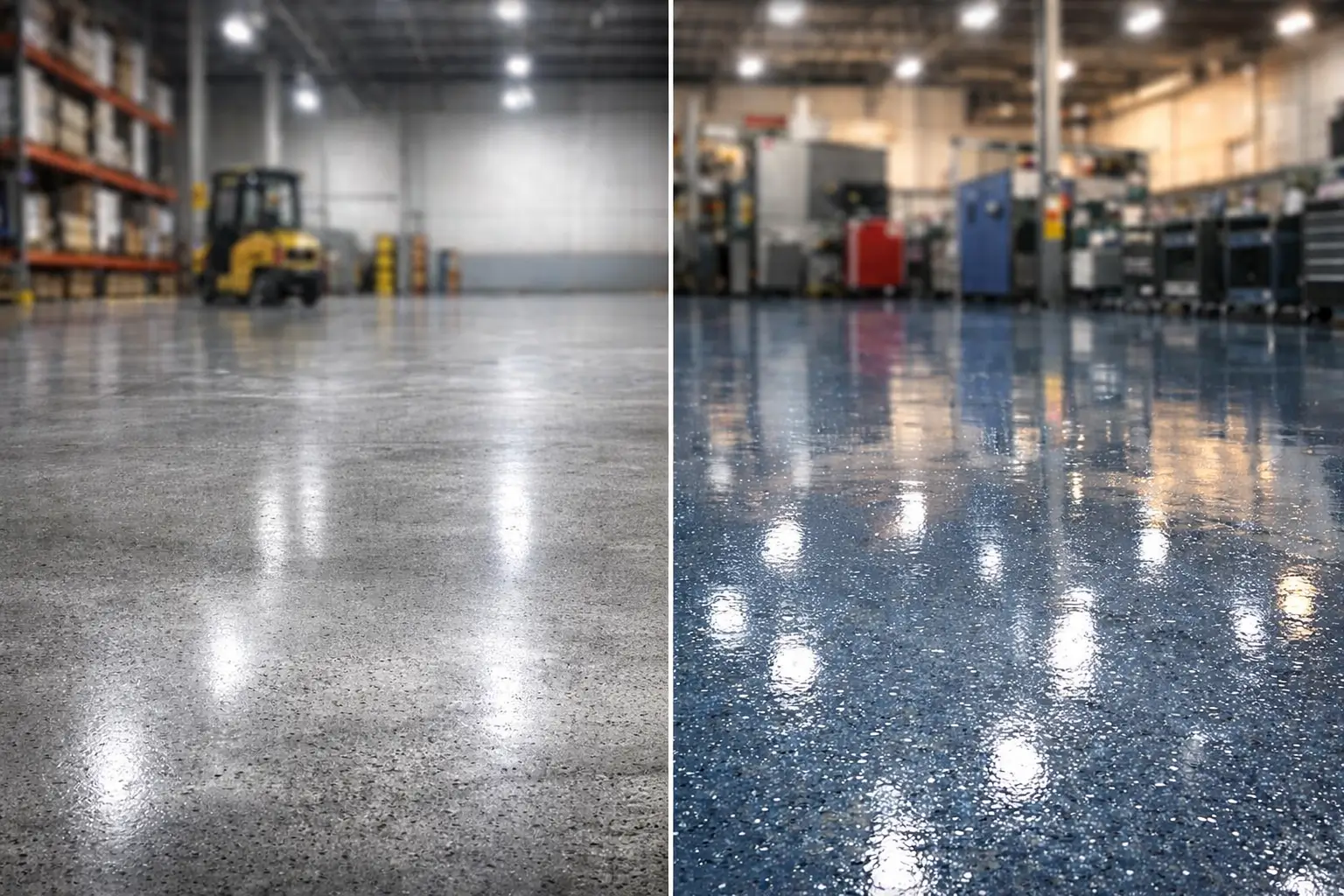
Industrial floors are not cosmetic upgrades — they are operational assets. When evaluating Epoxy vs Polished Concrete, businesses must consider how flooring impacts safety compliance, sanitation, downtime, maintenance budgets, and long-term capital planning in warehouses and food processing plants.
Choosing the wrong system increases risk. Choosing the right one between Epoxy vs Polished Concrete improves durability, safety, and cost control for years.
This deep comparison examines:
- Chemical resistance
- Lifecycle cost
- Slip resistance ratings
- Performance in warehouses
- Performance in food processing environments
Let’s evaluate both systems where it matters most.
Understanding the Two Flooring Systems – Epoxy vs Polished Concrete
What is Epoxy Flooring
Epoxy is a resin-based coating applied over prepared concrete. Once cured, it forms a seamless, hardened surface that bonds to the slab.
It can be installed as:
- Self-leveling systems
- High-build coatings
- Aggregate broadcast systems
- Chemical-resistant novolac systems
The key advantage is protection. Epoxy creates a barrier between the concrete and the operational environment.
What is Polished Concrete
Polished concrete is mechanically ground and densified using diamond abrasives and chemical hardeners.
It is not a coating. It is the refinement of the existing slab.
There is no topical layer to peel. Instead, the surface is hardened and polished to the desired sheen level.
Its strength lies in simplicity and durability under dry conditions.
Chemical Resistance: Where Protection Matters Most
Epoxy Chemical Performance
Epoxy flooring provides strong resistance against:
- Oils and lubricants
- Cleaning agents
- Many acids
- Solvents
- Food byproducts
- Salt exposure
In food processing plants where washdowns and sanitation chemicals are routine, epoxy performs reliably when properly specified.
High-performance formulations such as novolac epoxy are designed specifically for heavy chemical environments.
However, surface damage can compromise protection if maintenance is ignored.
In chemical-intensive environments, epoxy delivers superior defense.
Polished Concrete Chemical Performance
Polished concrete improves abrasion resistance but does not create a chemical barrier.
The slab remains porous at a microscopic level.
Acidic spills can:
- Etch the surface
- Cause staining
- Require mechanical re-polishing
In facilities with frequent exposure to acidic sanitizers or food byproducts, polished concrete can degrade over time.
For chemical-heavy applications, polished concrete presents greater long-term risk.
Lifecycle Costs: The Real Financial Comparison
Upfront cost rarely reflects the total cost of ownership.
Epoxy Lifecycle Cost
Initial installation cost is moderate to high, depending on system thickness and preparation.
Key cost factors include:
- Surface preparation
- Downtime during installation
- Periodic recoating
Lifespan typically ranges from 5 to 15 years, depending on traffic and chemical exposure.
If coatings fail due to poor preparation or excessive impact, resurfacing is required.
Epoxy offers predictable performance when maintained correctly.
Polished Concrete Lifecycle Cost
The initial installation cost is moderate and often competitive.
Maintenance requirements are lower because there is no coating to reapply.
Typical lifespan can exceed 15 to 20 years under suitable conditions.
Routine cleaning is simple and cost-effective.
However, repairing chemical damage or surface etching requires grinding and repolishing, which can be costly.
For dry warehouses with heavy traffic and minimal chemical exposure, polished concrete often provides lower total lifecycle cost.
For chemically aggressive environments, epoxy may prevent more expensive slab deterioration.
Slip Resistance Ratings and Workplace Safety
Slip resistance is measured using the coefficient of friction. Industrial facilities must comply with OSHA and food safety requirements.
Epoxy Slip Resistance
Epoxy systems can be engineered for traction using:
- Aggregate broadcast
- Textured finishes
- Matte sealers
Wet areas such as washdown zones can achieve high slip resistance when designed properly.
High-gloss epoxy without texture may be slippery. However, customization allows safety performance to match operational needs.
Epoxy offers flexibility in designing slip-resistant surfaces.
Polished Concrete Slip Resistance
Polished concrete often performs adequately in dry conditions.
However:
- Wet surfaces reduce traction
- Oil contamination increases the hazard
- Traction customization options are limited
Although densifiers improve hardness, they do not significantly enhance wet slip resistance.
In consistently wet environments, polished concrete carries a greater safety risk compared to textured epoxy systems.
Performance in Warehouses
Warehouses prioritize durability, reflectivity, and traffic tolerance.
Where Polished Concrete Performs Best
Polished concrete excels in:
- Distribution centers
- Logistics hubs
- High forklift traffic environments
- Dry storage operations
Benefits include:
- High light reflectivity
- Low maintenance
- Excellent abrasion resistance
- No risk of coating delamination
For large-scale warehouse operations without chemical exposure, polished concrete often provides the most efficient long-term solution.
Where Epoxy Performs Best in Warehouses
Epoxy adds value in:
- Battery charging stations
- Chemical storage areas
- Zoned traffic marking
- Safety color coding
It enhances visual organization and surface protection in higher-risk zones.
In mixed-use warehouse environments, epoxy is often installed selectively in critical areas.
Performance in Food Processing Plants
Food processing facilities face stricter demands:
- Frequent washdowns
- Exposure to organic acids
- Moisture cycling
- Regulatory compliance
Epoxy systems can be installed seamlessly with cove bases that integrate wall and floor transitions. This reduces contamination risk.
Specialized systems can include antimicrobial additives and high chemical resistance.
Polished concrete lacks the same level of chemical defense and moisture protection.
For most food processing environments, epoxy provides superior protection and compliance support.
The Risk of Choosing Incorrectly
Selecting polished concrete in a high-chemical facility may lead to:
- Surface etching
- Staining
- Premature degradation
- Increased maintenance costs
Selecting epoxy in a heavy impact warehouse without proper preparation may lead to:
- Delamination
- Peeling
- Operational downtime
Industrial floor failure disrupts operations and increases liability.
The cost of interruption often exceeds installation savings.
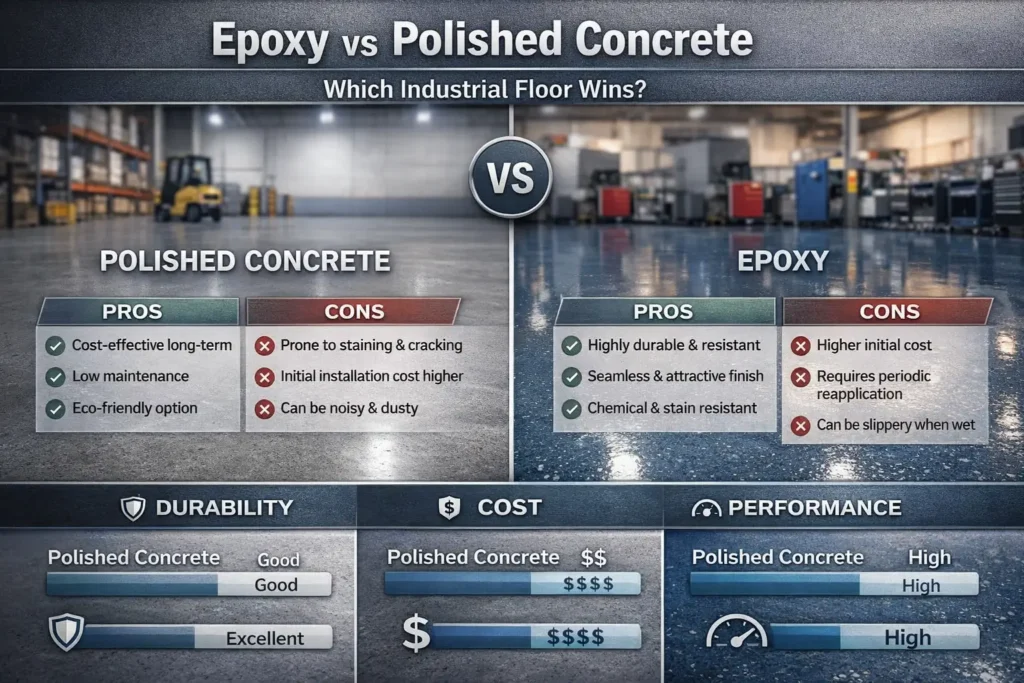
Final Verdict: Which Industrial Floor Wins?
There is no universal winner.
Polished concrete is ideal for:
- Dry warehouses
- High traffic distribution centers
- Facilities focused on long lifespan and low maintenance
Epoxy is ideal for:
- Food processing plants
- Chemical storage areas
- Wet washdown environments
- Facilities requiring enhanced slip resistance
The winning floor is the one aligned with your operational risk profile.
How to Make the Right Decision
Before choosing, evaluate:
- What chemicals contact the floor daily
- Frequency of washdowns
- Forklift and equipment traffic levels
- Required slip resistance ratings
- Ten-year maintenance budget projections
Industrial flooring is an infrastructure decision.
When matched correctly to operational demands, both Epoxy vs Polished Concrete can perform exceptionally well.
The difference lies in environmental intensity and long-term risk tolerance.
Frequently Asked Questions
Is epoxy more expensive than polished concrete?
Epoxy may have higher installation costs due to materials and preparation. However, in chemical-heavy environments, it may reduce long-term damage costs.
Can polished concrete meet food safety standards?
It may perform adequately in dry storage food facilities. In wet processing environments with chemical exposure, protective coatings are often preferred.
How long does epoxy flooring last?
Depending on traffic and maintenance, epoxy can last between 5 and 15 years before requiring recoating.
Is polished concrete slippery?
It performs well in dry conditions but may become slippery when wet or contaminated with oil.
Can epoxy floors be repaired?
Localized repairs are possible, though professional resurfacing may be required to maintain uniform appearance and performance.