
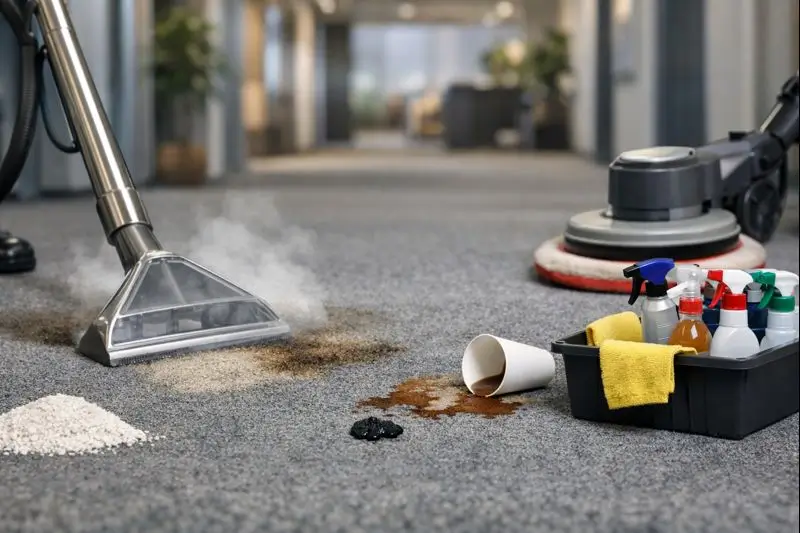
Commercial carpets in lobbies, hallways, and conference rooms face relentless abuse. Coffee spills during morning rushes, mud tracked in from rainy days, and mystery Carpet Stains that appear overnight all contribute to a worn, unprofessional appearance. For facility managers and business owners in the Greater Toronto Area, understanding which stain removal methods deliver results—and which waste time and money—makes the difference between carpets that last 7 years versus carpets that need replacement after 3.
This guide ranks six professional-grade stain removal methods based on effectiveness, cost per treatment, and suitability for different commercial environments. Each method includes specific application instructions, dwell times, and expected outcomes based on industry testing and real-world commercial cleaning experience.
Understanding Commercial Carpet Stains: Why High-Traffic Areas Are Different
Residential carpet cleaning advice fails in commercial settings for three reasons. First, commercial carpets endure 50 to 200 times more foot traffic than home carpets. Second, Carpet Stains in office buildings often sit for 8 to 12 hours before cleaning staff arrive, allowing them to set deeply into fibers. Third, commercial spaces require cleaning methods that dry within 2 to 4 hours to avoid disrupting business operations.
High-traffic commercial carpets typically feature low-pile nylon or polyester construction. These synthetic fibers resist staining better than natural fibers but require pH-balanced cleaning solutions to prevent fiber damage. Oil-based stains (food grease, cosmetics, petroleum residue) bond differently than water-based Carpet Stains (coffee, soda, wine), requiring distinct chemical approaches.
The most problematic commercial carpet stains fall into five categories: petroleum-based oils, protein-based organics (food, bodily fluids), tannin stains (coffee, tea, wine), dye transfer from clothing or bags, and embedded particulate matter (dirt, mud, concrete dust). Each category responds differently to the six methods ranked below.
Method 6: Hot Water Extraction (Steam Cleaning) — Score: 6.5/10
Best for: Deep quarterly cleaning, not immediate stain response Cost per treatment*: $0.08 to $0.15 per square foot Dry time: 6 to 24 hours Effectiveness on set stains: Moderate to low
Hot water extraction remains the industry standard for routine commercial carpet maintenance, but ranks lowest for stubborn stain removal in high-traffic areas. The method injects hot water mixed with detergent into carpet fibers at 150 to 200 PSI, then immediately extracts the water along with loosened soil.
This approach works well for general dirt removal across large areas but struggles with set-in Carpet Stains for two reasons. First, the rapid injection-extraction cycle provides only 3 to 5 seconds of chemical contact time—insufficient for breaking down bonded stains. Second, the high water volume often spreads stains laterally into surrounding fibers rather than lifting them vertically out of the carpet.
For commercial spaces that cannot close for extended periods, the 6 to 24 hour dry time creates significant operational challenges. Wet carpets in Toronto office towers during winter months can take even longer to dry due to lower ambient temperatures and humidity levels.
When to use this method: Schedule hot water extraction for quarterly deep cleaning during off-hours or weekends, but rely on other methods for immediate stain response during business hours.
Method 5: Dry Compound Cleaning — Score: 7/10
Best for: Maintenance cleaning between deep cleans Cost per treatment: $0.12 to $0.20 per square foot Dry time: 30 to 45 minutes Effectiveness on set stains: Low to moderate
Dry compound cleaning uses absorbent particles (typically corn cob granules or synthetic polymers) mixed with cleaning solvents and detergents. Technicians spread the moist compound across carpets, work it into fibers with a counter-rotating brush machine, allow 15 to 20 minutes of dwell time, then vacuum thoroughly.
The primary advantage lies in minimal downtime—carpets remain walkable throughout the process and fully dry within 30 to 45 minutes. This makes dry compound cleaning ideal for retail environments, bank lobbies, and medical offices where closing even a section of flooring disrupts customer service.
However, the method’s stain removal capability remains limited. The compound excels at absorbing fresh surface-level spills and general soil but cannot generate the chemical reaction or mechanical agitation necessary to break apart set-in stains. Testing shows dry compound cleaning removes approximately 40% to 60% of embedded staining compared to 75% to 90% removal rates from wet extraction methods.
When to use this method: Deploy dry compound cleaning for weekly or bi-weekly maintenance in high-visibility areas where appearance matters but deep staining hasn’t occurred. Switch to wet methods when stains persist after dry treatment.
Method 4: Bonnet Cleaning (Spin Pad Method) — Score: 7.5/10
Best for: Regular maintenance of cut-pile commercial carpets Cost per treatment: $0.06 to $0.10 per square foot Dry time: 1 to 2 hours Effectiveness on set stains: Moderate
Bonnet cleaning employs a rotary floor machine fitted with an absorbent pad soaked in cleaning solution. The spinning pad—rotating at 175 to 300 RPM—absorbs soil from the top one-third of carpet fibers through mechanical friction and chemical action.
This method gained popularity in hotels and office buildings because it combines reasonable soil removal with quick dry times. The spinning action provides more mechanical agitation than dry compound methods, helping to break apart light to moderate Carpet Stains. Treatment costs remain low since the same rotary machines used for hard floor buffing can be repurposed with bonnet pads.
The limitation becomes apparent with stubborn, deep Carpet Stains. Bonnet cleaning only addresses the upper portion of carpet pile, leaving stains embedded in lower fiber levels untouched. Additionally, without proper pad changing every 200 to 300 square feet, the method can redistribute soil rather than remove it—essentially moving stains from one area to another.
When to use this method: Implement bonnet cleaning as a bi-weekly or weekly interim maintenance step between quarterly deep extractions. Effective for general appearance maintenance in office corridors, hotel hallways, and conference centers where foot traffic creates surface-level soiling.
Method 3: Encapsulation Cleaning — Score: 8/10
Best for: Routine maintenance with minimal downtime Cost per treatment: $0.08 to $0.14 per square foot Dry time: 20 to 45 minutes Effectiveness on set stains: Moderate to good
Encapsulation represents a significant advancement in commercial carpet maintenance. The process applies polymer-based cleaning solutions that crystallize around soil particles as they dry. Once crystallized, the encapsulated soil loses adhesion to carpet fibers and can be removed through routine vacuuming over the following 24 to 48 hours.
Counter-rotating brush machines or cylindrical brush systems work the encapsulation chemistry deep into carpet pile, providing superior fiber penetration compared to bonnet methods. The polymer formulations surround both water-based and oil-based soils, making encapsulation more versatile than single-chemistry approaches.
For commercial facilities, encapsulation offers three major operational advantages. First, carpets dry in 20 to 45 minutes—fast enough to clean during lunch breaks or between business shifts. Second, soil removal continues for 1 to 2 days after treatment as normal foot traffic breaks up encapsulated particles. Third, the method leaves minimal residue compared to traditional detergent-based cleaning, reducing re-soiling rates by 30% to 40%.
The method’s limitation appears with deeply set Carpet Stains that have bonded to fibers at a molecular level. While encapsulation removes 70% to 80% of typical commercial staining, it cannot match the performance of hot water extraction with extended dwell times on severe, aged stains.
When to use this method: Make encapsulation your primary maintenance cleaning method for most commercial spaces, performing treatments every 4 to 8 weeks depending on traffic levels. Reserve wet extraction or spot treatment for stubborn Carpet Stains that encapsulation doesn’t fully remove.
Method 2: Targeted Spot Treatment with Chemistry Selection — Score: 9/10
Best for: Immediate response to specific stains Cost per treatment: $0.50 to $3.00 per stain (depending on size) Dry time: 15 minutes to 2 hours Effectiveness on set stains: Good to excellent
Professional spot treatment succeeds where general cleaning fails because it matches specific chemistry to specific stain types. Rather than applying a universal cleaning solution, trained technicians identify the stain category and select from an arsenal of targeted products: enzyme digesters for protein-based stains, alkaline detergents for acidic food Carpet Stains, solvent-based products for oil and grease, oxidizing agents for tannin stains, and reducing agents for dye transfer.
The process begins with stain identification. Coffee and tea Carpet Stains respond to alkaline cleaners with pH levels between 9 and 11. Red wine requires oxidizing agents that break down anthocyanin pigments. Chewing gum and adhesives need solvent-based removers. Applying the wrong chemistry not only fails to remove the stain but can set it permanently or spread it deeper into backing material.
Effective spot treatment follows a five-step protocol. First, remove any solid residue without rubbing (blot liquids, scrape solids). Second, apply the selected chemistry and allow proper dwell time—typically 3 to 10 minutes depending on product formulation. Third, agitate gently with a carpet brush or tamping tool to work chemistry into fiber. Fourth, extract or blot the dissolved staining. Fifth, rinse with clean water to remove chemical residue that could attract future soil.
Time sensitivity dramatically affects outcomes. Stains treated within 30 minutes of occurrence show 85% to 95% removal rates. The same stains treated after 24 hours show only 60% to 75% removal. After one week, removal rates drop to 40% to 60% as stains chemically bond with fiber dyes.
When to use this method: Implement spot treatment as your first response to any visible stain in commercial spaces. Train building staff or cleaning teams to identify common stain types and apply appropriate chemistry within the first hour. For stains that resist initial spot treatment, escalate to Method 1.
Method 1: Hot Water Extraction with Extended Dwell Time and Pre-Treatment — Score: 9.5/10
Best for: Severe Carpet Stains, periodic deep restoration Cost per treatment: $0.15 to $0.30 per square foot (for localized treatment) Dry time: 4 to 12 hours Effectiveness on set stains: Excellent
The highest-ranked method combines chemical pre-treatment, extended contact time, and hot water extraction to achieve maximum stain removal from commercial carpets. Unlike quick-pass steam cleaning, this approach treats stubborn Carpet Stains as a multi-stage restoration process rather than a maintenance task.
The procedure begins with stain-specific pre-treatment applied 10 to 20 minutes before extraction. For protein-based stains, enzyme digesters break down organic matter at a molecular level. For oil-based stains, emulsifying pre-sprays surround oil molecules and prepare them for water extraction. For tannin stains, oxidizing agents chemically alter pigment structure. This pre-treatment phase addresses the chemical bonding that makes Carpet Stains”stubborn” in the first place.
After sufficient dwell time, technicians perform hot water extraction using water heated to 180 to 210 degrees Fahrenheit. The elevated temperature accelerates chemical reactions and improves soil suspension. Multiple slow extraction passes—rather than a single quick pass—provide thorough soil removal. High-quality truck-mounted systems generate 500 to 800 PSI of cleaning pressure and 15 to 20 inches of water lift on the vacuum side, creating the hydraulic force necessary to extract deeply embedded staining.
For maximum effectiveness, technicians may perform a secondary rinse extraction using acidic rinse agents (pH 4 to 6) that neutralize alkaline cleaning residues and restore carpet to its natural pH level. This step prevents residue-based re-soiling and extends the time between future cleanings.
The tradeoff for superior performance is operational disruption. Treated areas require 4 to 12 hours to dry completely, depending on air circulation, humidity levels, and carpet construction. Commercial facilities must schedule this level of cleaning during closed hours, weekends, or by sectioning buildings to maintain partial operations.
When to use this method: Deploy this approach for quarterly or semi-annual deep restoration, for remediation of neglected carpeting before important events, and for severe stain situations where other methods have failed. In Toronto’s commercial market, many facility managers schedule this treatment before fiscal year-end events, major client visits, or lease renewal inspections.

Special Considerations for GTA Commercial Environments
Toronto’s climate creates unique carpet staining challenges that affect method selection. Winter months bring road salt tracked into lobbies and corridors. The calcium chloride and sodium chloride in de-icing products create white crusty residues that resist standard cleaning and can permanently damage carpet backing if not addressed promptly. Salt residue requires acidic neutralizers (pH 3 to 5) applied before hot water extraction.
Spring melt periods produce mud and sediment staining as melting snow carries particulates into buildings. These stains respond well to encapsulation methods once the bulk soil has been removed, since the polymer chemistry binds to the fine particles that create the discoloration.
High-rise office towers in the financial district face another challenge: airborne urban particulates that settle on carpets and oxidize over time. This creates a grey, dingy appearance that requires oxidizing agents or ozone treatment to restore original color—methods beyond the scope of standard cleaning.
Cost-Benefit Analysis: Selecting the Right Method for Your Facility
Commercial cleaning budgets must balance immediate costs against long-term carpet lifespan. Buildings that rely exclusively on low-cost methods (bonnet cleaning or dry compound) may spend $0.06 to $0.10 per square foot monthly but require carpet replacement every 3 to 5 years. Facilities that invest in quarterly deep extraction with monthly encapsulation spend $0.12 to $0.18 per square foot monthly but extend carpet life to 7 to 10 years.
For a 10,000 square foot commercial space in the GTA, this translates to:
Low-cost maintenance approach:
- Monthly cleaning: $600 to $1,000
- Carpet replacement every 4 years: $25,000 to $35,000
- Annualized total cost: $13,250 to $20,750
Balanced maintenance approach:
- Monthly cleaning: $1,200 to $1,800
- Carpet replacement every 8 years: $25,000 to $35,000
- Annualized total cost: $17,525 to $25,975
While the balanced approach costs more monthly, it delivers superior appearance, better indoor air quality through more thorough soil removal, and reduced business disruption from emergency restorations or early replacement projects.
Implementation Protocol: Building an Effective Stain Response System
Commercial facilities in the GTA should implement a three-tier stain management protocol:
Tier 1 – Immediate Response (0 to 2 hours): Train building staff or daytime cleaning crews to identify and treat fresh spills using targeted spot treatment (Method 2). Equip facilities with basic spot cleaning kits containing separate solutions for protein stains, tannin stains, and oil-based stains. Response within the first 2 hours prevents 70% to 80% of would-be stubborn Carpet Stains from setting.
Tier 2 – Regular Maintenance (Weekly to Monthly): Deploy encapsulation cleaning (Method 3) as your primary maintenance method for high-traffic areas. Schedule treatments every 2 to 4 weeks in lobbies, corridors, and conference rooms. Supplement with bonnet cleaning (Method 4) in moderate-traffic areas every 4 to 6 weeks.
Tier 3 – Deep Restoration (Quarterly to Semi-Annually): Schedule hot water extraction with pre-treatment (Method 1) every 3 to 6 months depending on facility traffic levels. Coordinate timing with low-occupancy periods—winter holidays, summer vacation periods, or planned building closures. Budget 8 to 12 hours of downtime per section to allow proper drying.
Measuring Cleaning Effectiveness: Beyond Visual Assessment
Professional facility managers track carpet cleaning performance through objective metrics rather than subjective appearance ratings. Three measurements provide reliable performance data:
Soil load testing: Use a white cotton towel dampened with cleaning solution and rub across a 12-inch section of carpet. Compare the towel discoloration before and after cleaning to assess soil removal rates. Effective cleaning should show 75% or greater reduction in transferred soil.
pH testing: Test carpet pH 24 hours after cleaning using litmus strips or a pH meter. Properly cleaned and rinsed carpet should measure between 6.5 and 8.0 pH. Readings above 9.0 indicate cleaning residue that will accelerate re-soiling.
Moisture testing: Use a moisture meter to confirm carpet reaches below 15% moisture content before reopening to foot traffic. Carpets with higher moisture levels risk mold growth, odor development, and delamination of backing materials.
When to Replace Rather Than Clean: Economic Breakpoint Analysis
Even the most effective cleaning methods cannot indefinitely restore carpets that have reached end-of-life. Facility managers should replace rather than continue cleaning when:
The carpet shows fiber wear in traffic lanes where backing is visible through the pile. No amount of cleaning restores structural integrity once fibers have worn away.
Permanent staining covers more than 15% of visible areas despite professional restoration attempts. At this threshold, replacement costs less over a 5-year period than continued specialized cleaning.
Seam separation or backing deterioration appears in multiple locations. These structural failures create tripping hazards and will worsen regardless of cleaning quality.
Persistent odors return within 48 hours of deep cleaning, indicating contamination has penetrated backing materials or subfloor. Odor-causing bacteria living below the carpet pile cannot be addressed through surface cleaning.
For GTA commercial spaces, typical replacement costs range from $2.50 to $7.00 per square foot installed, depending on fiber quality and backing construction. When annual cleaning costs to maintain minimally acceptable appearance exceed 30% to 40% of replacement cost, financial analysis favors replacement.
Frequently Asked Questions
How long should I wait after stain treatment before allowing foot traffic?
For spot treatment with extraction, wait until the treated area feels dry to touch—typically 15 to 30 minutes with adequate air circulation. For encapsulation cleaning, carpets can handle light foot traffic immediately, though staying off treated areas for 20 minutes allows polymer formation. For hot water extraction, wait until moisture content drops below 15%—typically 4 to 8 hours with commercial air movers, up to 12 hours in humid conditions.
Can I use household stain removers on commercial carpets?
Household products often contain high pH levels (above 11) or undisclosed solvents that damage commercial carpet fibers or alter dye colors. Additionally, many household cleaners leave sticky residues that attract soil faster than the original stain. Professional-grade products formulated for commercial use provide better performance and include buffering agents that protect fibers.
Why do some stains reappear days after professional cleaning?
Stain wicking occurs when cleaning moisture carries dissolved staining material deep into carpet backing. As the carpet dries, capillary action draws the staining back up through fibers to the surface. Proper extraction technique removes dissolved soil before it can wick, and quick drying times (under 6 hours) minimize capillary action. If wicking occurs, re-treat the area with extraction focused on the backing layer.
What’s the difference between cleaning and restoring carpet appearance?
Cleaning removes soil, bacteria, and staining from fibers. Restoration addresses physical damage to fibers—crushing, matting, or discoloration from wear. Heavily trafficked areas may be clean but still appear worn because fiber structure has degraded. Grooming with pile-lifting equipment after cleaning helps restore texture, but cannot reverse permanent fiber damage from years of traffic.
How do I remove stains from carpet tiles versus broadloom carpet?
Carpet tiles allow removal of individual tiles for intensive treatment or replacement without disturbing surrounding areas. For stubborn Carpet Stains on tiles, remove the affected tile, treat it separately with appropriate chemistry, and reinstall after thorough drying. This targeted approach works well for small concentrated stains. Broadloom carpet requires in-place treatment and carries higher risk of color variation if aggressive chemistry affects dye stability.
Do professional cleaners in Toronto need special certification?
The Institute of Inspection, Cleaning and Restoration Certification (IICRC) provides industry-standard training for carpet cleaning technicians. IICRC-certified companies demonstrate knowledge of proper cleaning methods, chemistry selection, and equipment operation. While Ontario doesn’t legally require certification for commercial carpet cleaning, certified technicians typically deliver superior results and cause less damage than uncertified operators.
About MCA Group Commercial Cleaning
MCA Group provides commercial carpet cleaning services throughout the Greater Toronto Area, including Toronto, Mississauga, Brampton, Vaughan, Markham, and Richmond Hill. Our IICRC-certified technicians use targeted stain removal protocols and professional-grade equipment to restore carpet appearance in office buildings, medical facilities, retail spaces, and industrial properties. We offer flexible scheduling for minimal business disruption and provide detailed cleaning reports tracking soil removal performance.
*Cost per treatment: Schedule an Appointment for an exact quote


