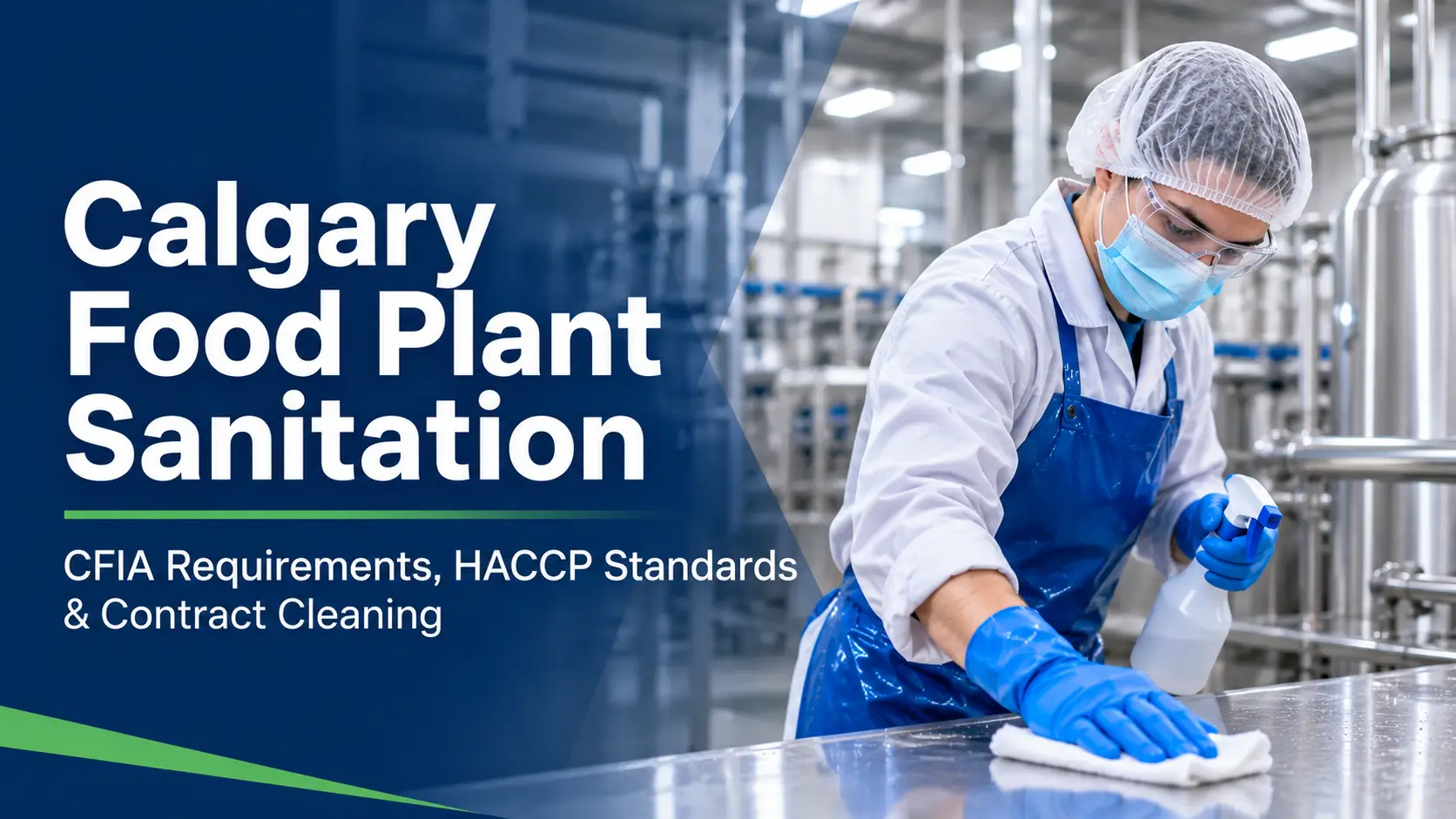
If your Calgary food plant ships product outside Alberta, the Canadian Food Inspection Agency (CFIA) expects your sanitation to be written down, done the same way every shift, checked, and recorded. Clean-looking equipment isn’t enough. An inspector or a third-party auditor wants to see that a defined procedure was followed, that someone verified it worked, and that there’s a record of what happened when it didn’t.
The same standard applies whether your own night crew does the cleaning or a contractor does. The sections below cover what the Safe Food for Canadians Regulations (SFCR) and HACCP principles mean for daily cleaning in a food facility, where Calgary’s conditions make the work harder, and which parts of the program a contract crew can take on while your QA team keeps the rest.
Who regulates food plant sanitation in Calgary?
It depends on where your product goes.
- If your product leaves Alberta, or you export or import food, you fall under the federal Safe Food for Canadians Regulations, which the CFIA administers. Most of these businesses need a Safe Food for Canadians licence and a written Preventive Control Plan (PCP).
- If you make and sell product only within Alberta, provincial rules apply. Food establishments fall under Alberta’s Food Regulation under the Public Health Act, and Alberta Health Services Environmental Public Health does the inspections. Alberta Agriculture and Irrigation oversees provincially licensed meat facilities under the province’s Meat Inspection Act.
- Your customers may hold you to a third standard. Many Calgary processors that supply national grocers or food-service distributors also hold a GFSI-benchmarked certification such as SQF, BRCGS or FSSC 22000. Those audits often look at sanitation records more closely than a routine government inspection does.
In all three cases, sanitation is a foundation item. The CFIA notes that even businesses that don’t need a written PCP still need preventive controls in place, including sanitation and pest control.
What the SFCR expects from sanitation
Part 4 of the SFCR holds most of the federal food safety requirements. The CFIA states that these requirements are built on Good Manufacturing Practices and the principles of Hazard Analysis Critical Control Point (HACCP).
For a licence holder, the written PCP has to show more than what you clean. Under section 89, the plan sets out control measures, how they’re monitored, the corrective action when something fails, and how you verify the plan is working. For sanitation, that means:
- A written procedure for each area and piece of equipment, often called a Sanitation Standard Operating Procedure (SSOP). Each one names the chemical, concentration, water temperature, contact time, tools and the person responsible.
- A master sanitation schedule listing what gets cleaned daily, weekly, monthly and quarterly. It should include the places people forget: overhead structures, drains, cooler evaporator coils, dock levellers and the walls behind equipment.
- Monitoring, usually a pre-operational inspection before production starts, signed by someone accountable.
- Corrective action for a surface that fails inspection: re-clean it, re-inspect it, and decide whether any product was affected.
- Verification that the program works over time, such as ATP swab trends, environmental monitoring results and record reviews.
- Records that are kept, legible and easy to pull up for an inspector.
Where HACCP fits
HACCP is a seven-principle system for finding and controlling food safety hazards: conduct a hazard analysis, identify critical control points (CCPs), set critical limits, monitor, take corrective action, verify, and keep records.
In most plants, sanitation isn’t a CCP. It’s a prerequisite program, one of the baseline conditions (with pest control, maintenance, and employee hygiene) that must be in place before the HACCP plan can work. It takes up less room in the plan than a CCP, but if your prerequisite programs are weak, an auditor will question every CCP that depends on them.
The CFIA’s own HACCP-based programs reflect this. The Food Safety Enhancement Program (FSEP), long used by meat, dairy, and processed food operators, is one recognized way of building a PCP on HACCP principles.
The sanitation cycle an auditor expects to see
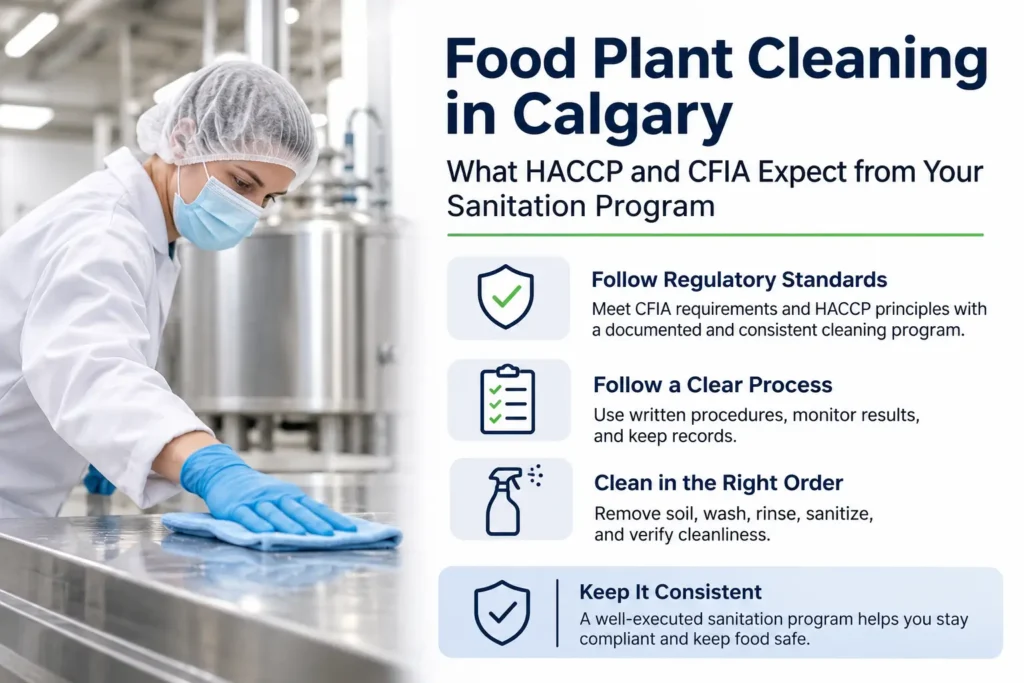
A defensible wet-clean follows the same order every time. Skipping or reversing a step is the most common reason a surface passes a visual check but fails a swab.
| Step | What happens | Why it matters |
|---|---|---|
| 1. Prepare | Lockout/tagout, cover or remove packaging and ingredients, disassemble equipment | Protects workers and keeps chemicals and water spray away from product |
| 2. Dry clean | Scrape and sweep out product residue before any water | Water spreads soil and creates more wastewater |
| 3. Pre-rinse | Low-pressure rinse, top to bottom | Removes loose soil without spraying it onto clean areas |
| 4. Wash | Apply detergent matched to the soil (alkaline for fats and proteins, acid for mineral scale), scrub and allow contact time | Sanitizers don’t work through a layer of soil or biofilm |
| 5. Rinse | Remove detergent completely | Detergent residue can neutralize the sanitizer |
| 6. Inspect | Visual check with a flashlight, plus ATP swabs where the plan calls for them | Confirms the surface is actually clean before sanitizing |
| 7. Sanitize | Apply a food-contact sanitizer at label concentration for the label contact time | This step reduces microorganisms to safe levels. It only works on a clean surface |
| 8. Reassemble and record | Reassemble with clean hands and tools, then sign the sanitation record | The record is what proves steps 1 to 7 happened |
Two plain-language terms that come up in audits:
- Contact time (also called dwell time) is how long a sanitizer must stay wet on a surface to work, as stated on the product label. If someone wipes or rinses it off early, the sanitizing step didn’t happen.
- An ATP swab is a quick test for organic residue on a surface. It doesn’t identify bacteria, but a high reading means the surface isn’t clean enough to sanitize yet.
Allergen changeovers
When a line switches from a product containing an allergen (milk, eggs, peanuts, tree nuts, sesame, wheat, soy, mustard, fish, crustaceans and shellfish, sulphites) to one that doesn’t, the changeover clean is a food safety control. It needs its own validated procedure, its own inspection and its own record, often with allergen-specific test kits. Mixing it into routine nightly cleaning is a common audit finding.
Ready-to-eat areas and Listeria
If you produce ready-to-eat foods, Health Canada’s policy on Listeria monocytogenes expects an environmental monitoring program. In practice, cleaning crews need to understand zoning: tools, mops, and footwear used in raw or non-food zones never go into ready-to-eat zones, and drains are cleaned with dedicated equipment so they don’t spray contamination upward.
Calgary conditions that make food plant cleaning harder
A sanitation program written for a generic plant can miss problems specific to Calgary.
Winter at the loading dock
Calgary processors in the southeast industrial areas (Foothills, Great Plains, East Shepard), in the northeast near YYC, and in distribution operations out toward Balzac run dock doors all winter. Washdown water that escapes onto dock plates and aprons freezes, which creates a slip hazard and a place for debris to collect. Your sanitation plan needs squeegee-and-dry steps at doorways and a clear rule on where washdown water can go.
Chinook freeze-thaw cycles
When the temperature swings from deep cold to above zero in a day, condensation forms on cold surfaces near doors and in coolers. Condensation dripping from overheads onto product zones is a known contamination source, so overhead cleaning and condensation checks deserve more attention here than a standard schedule gives them.
Dry air and dust
Calgary’s dry climate keeps dust, flour and ingredient powders in the air longer, especially in bakery, grain, spice and dry-blend operations. Dry-clean steps, dusting of beams, conduit and light fixtures, and HEPA vacuuming in place of compressed air all help keep dust off product-contact surfaces.
Gritty floors
Gravel and grit tracked in through the winter wear down floor coatings and grout lines. Cracked floors and failed sealant hold water and bacteria, so floor condition belongs on the sanitation inspection list as well as the maintenance list.
In-house sanitation crew vs. a contract cleaning crew
Most Calgary plants use one of three models: their own sanitation staff, a contractor, or a mix (for example, in-house daily line sanitation with a contractor handling deep cleaning, high-level cleaning, and specialty work).
| Factor | In-house crew | Contract crew |
|---|---|---|
| Knowledge of your equipment | Usually deep, built over time | Needs onboarding and written SSOPs from day one |
| Coverage when staff are absent | Your problem to solve | Contractor supplies backup staff |
| Training and certification records | You maintain them | Contractor maintains them; you should request copies |
| Specialty equipment (dry ice blasting, lifts, high-pressure units) | Capital cost and maintenance on you | Brought in as needed |
| Accountability in an audit | Direct | Shared. Your PCP must still describe and verify the contractor’s work |
In either model, the plant stays responsible for its PCP. A contractor carries out the procedures, and your QA team verifies them. Before you sign with a cleaning contractor, confirm that they will work from your SSOPs, sign your records in your format, follow your zoning and allergen rules, and share their training records.
Worker safety: the Alberta side of food plant sanitation
Food plant sanitation is some of the most hazardous work in the building, which is why safety requirements belong in any cleaning contract. In Alberta, that means the Occupational Health and Safety Act, Regulation and Code, including:
- Hazardous energy control (lockout) before anyone puts their hands inside a mixer, slicer, conveyor or grinder.
- WHMIS 2015 training for everyone who handles cleaning chemicals, with Safety Data Sheets on site. Strong alkaline and acid cleaners and chlorine-based sanitizers cause serious burns and must never be mixed.
- Confined space entry rules for tanks, silos, pits and some large vessels.
- Working-at-heights rules for overhead cleaning from lifts.
- WCB-Alberta coverage for everyone working on your site.
Ask any contractor for proof of WCB-Alberta coverage, liability insurance and current training records before they start.
How MCA Group approaches food plant cleaning in Calgary
MCA Group has provided commercial and industrial cleaning since 1993 and has served more than 5,000 businesses. For Calgary food processors, we work inside your existing food safety program:
- We follow your written SSOPs and fill in your sanitation logs in your format, so your QA team can check our work without translating it.
- Our team holds WHMIS, Confined Spaces, Boom Lift and Scissor Lift certifications. We’re fully bonded and insured, and our staff are trained and background-checked.
- Dry ice blasting cleans equipment and ovens without adding water, which helps where moisture is a hazard. We use power washing, steam detailing and floor restoration for docks, floors and heavy soil.
- We schedule around production: overnight and between-shift sanitation, weekend deep cleans and shutdown cleaning, plus day porter service for welfare areas, washrooms and lunchrooms.
- We inspect our own work and adjust when a pre-op inspection or swab result shows a gap.
If your plant is also storing or distributing product, see our industrial and warehouse cleaning in southeast Calgary page.
Frequently asked questions
Does CFIA require a written sanitation program?
If your Calgary food business holds a Safe Food for Canadians licence, MCA Group’s understanding is that your written Preventive Control Plan must cover sanitation, including procedures, monitoring, corrective action, verification and records. Businesses that don’t need a written plan must still have sanitation and pest control in place. Use the CFIA’s interactive PCP tool to confirm your status.
Is sanitation a critical control point under HACCP?
Usually not. In most food plants, sanitation is a prerequisite program that supports the HACCP plan rather than a critical control point within it. Some specific steps, such as allergen changeover cleaning, may be treated as a control measure with its own validation and records. Your food safety lead decides this in your hazard analysis.
Can a contract cleaning company do our food plant sanitation?
Yes. Many Calgary processors use a contractor for some or all of their sanitation. The plant stays responsible for its Preventive Control Plan, so the contractor should follow your SSOPs, complete your records and respect your zoning and allergen rules. MCA Group works this way and provides crew training records on request.
What’s the difference between cleaning and sanitizing?
Cleaning removes visible soil, grease, product residue and biofilm using detergent, scrubbing and rinsing. Sanitizing applies a food-contact sanitizer at the label concentration and contact time to reduce microorganisms to safe levels. Sanitizing only works on a surface that has already been cleaned, which is why the order of steps matters.
How much does food plant cleaning cost in Calgary?
Cost depends on your plant’s size, the number of lines, how often they’re sanitized, allergen changeovers, specialty work like dry ice blasting, and whether cleaning happens overnight or between shifts. MCA Group provides a free estimate after reviewing your facility and sanitation schedule.
Get a sanitation plan that holds up to an audit
If an SQF or BRCGS audit is coming up, your current crew is missing pre-op inspections, or you’re adding a line or a shift, it’s a good time to review who owns which part of your sanitation program. MCA Group will walk your Calgary plant, review your master sanitation schedule and give you a scope and price that fits your production.
Get a Free Estimate or call (403) 488-3393.
Sources for fact-checking
- CFIA, Preventive controls and SFCR regulatory requirements: https://inspection.canada.ca/en/preventive-controls
- CFIA, Preventive food safety controls toolkit: https://inspection.canada.ca/en/food-safety-industry/toolkit-food-businesses/preventive-food-safety-controls
- Safe Food for Canadians Regulations, s. 86 and s. 89: https://laws-lois.justice.gc.ca/eng/regulations/SOR-2018-108/
- CFIA, Food Safety Enhancement Program approach to a PCP: https://inspection.canada.ca/en/preventive-controls/preventive-control-plans/food-safety-enhancement-program
- Alberta Food Regulation, Meat Inspection Act and OHS Code: verify current references on alberta.ca and open.alberta.ca before publishing